Dog in Car Law UK: What Rule 57 Actually Means
Search for whether it is illegal to drive with your dog loose in the car and you will find two confident answers, both of them wrong. One says you face a £5,000 fine. The other says there is no law at all. The truth sits between them, and it matters more than either camp suggests, because the fine is not actually the part that should worry you.
Here is what the law says, what it costs in practice, and what counts as a proper restraint.
Is it illegal to drive with your dog loose in the car?
Not directly. There is no offence called “driving with an unrestrained dog”. You cannot be pulled over and ticketed for it the way you can for a broken brake light.
But Rule 57 of the Highway Code covers it, and the way the Highway Code is built means an advisory rule can still land you in front of a magistrate.
What Rule 57 actually says
“When in a vehicle make sure dogs or other animals are suitably restrained so they cannot distract you while you are driving or injure you, or themselves, if you stop quickly.”
The rule then names four acceptable restraints: a seat belt harness, a pet carrier, a dog cage, or a dog guard. That list is worth remembering, because it is the standard you would be measured against.
Why an advisory rule still bites
The Highway Code splits its rules into two kinds. Rules that are legal requirements use MUST or MUST NOT in capitals and cite the Act behind them. Rule 57 does neither, so breaking it is not an offence on its own.
The Code’s own introduction explains what happens instead: advisory rules may be used in evidence in court proceedings brought under the Traffic Acts. Rule 57 is not the charge. It is the evidence for one.
What it actually costs
If your dog distracts you while you are driving, the offence you are looking at is careless driving under section 3 of the Road Traffic Act 1988. What follows depends on how far it goes.
Stopped at the roadside
An officer can issue a fixed penalty notice on the spot: £100 and three penalty points. This is the realistic outcome for most drivers, and it is the number worth planning around.
If it reaches court
Careless driving carries a maximum fine of £5,000 and up to nine penalty points. A court can also disqualify you or order a retest. This is the headline figure you see quoted everywhere, but it sits at the top of the range and usually follows a collision rather than a routine stop.
Your insurance
This is the part that should worry you more than the fine. If you have an accident and your dog was unrestrained, an insurer can argue you were not in proper control of the vehicle. That can reduce a payout or void the claim entirely, which turns a bent wing into a bill you pay yourself.
A £15 harness against a five-figure claim is not a close call.
What counts as a suitable restraint
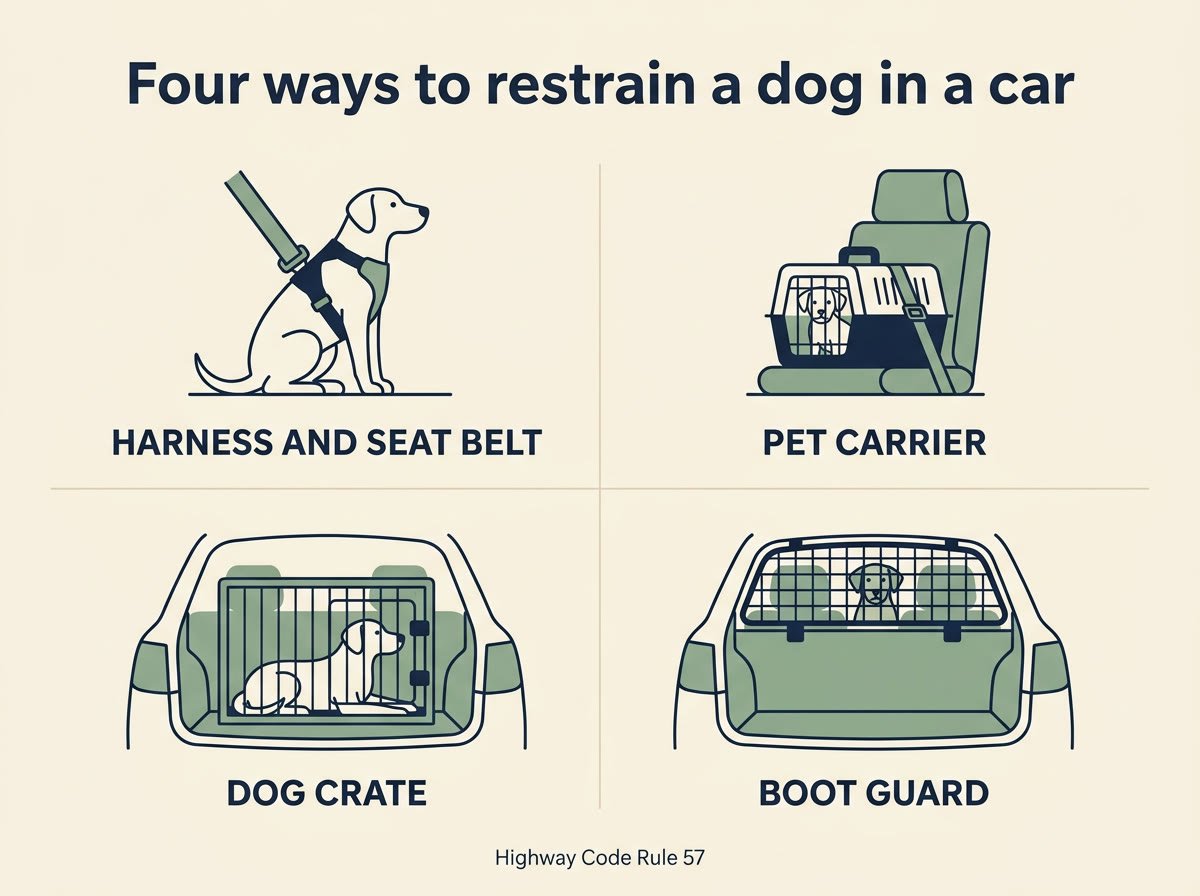
Any of these four will satisfy Rule 57:
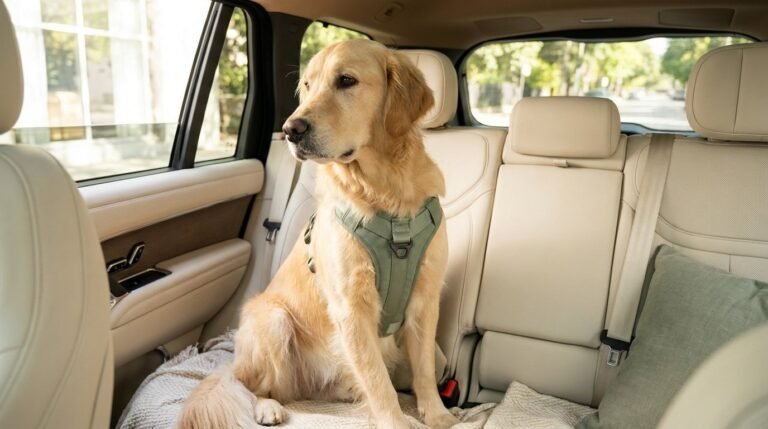
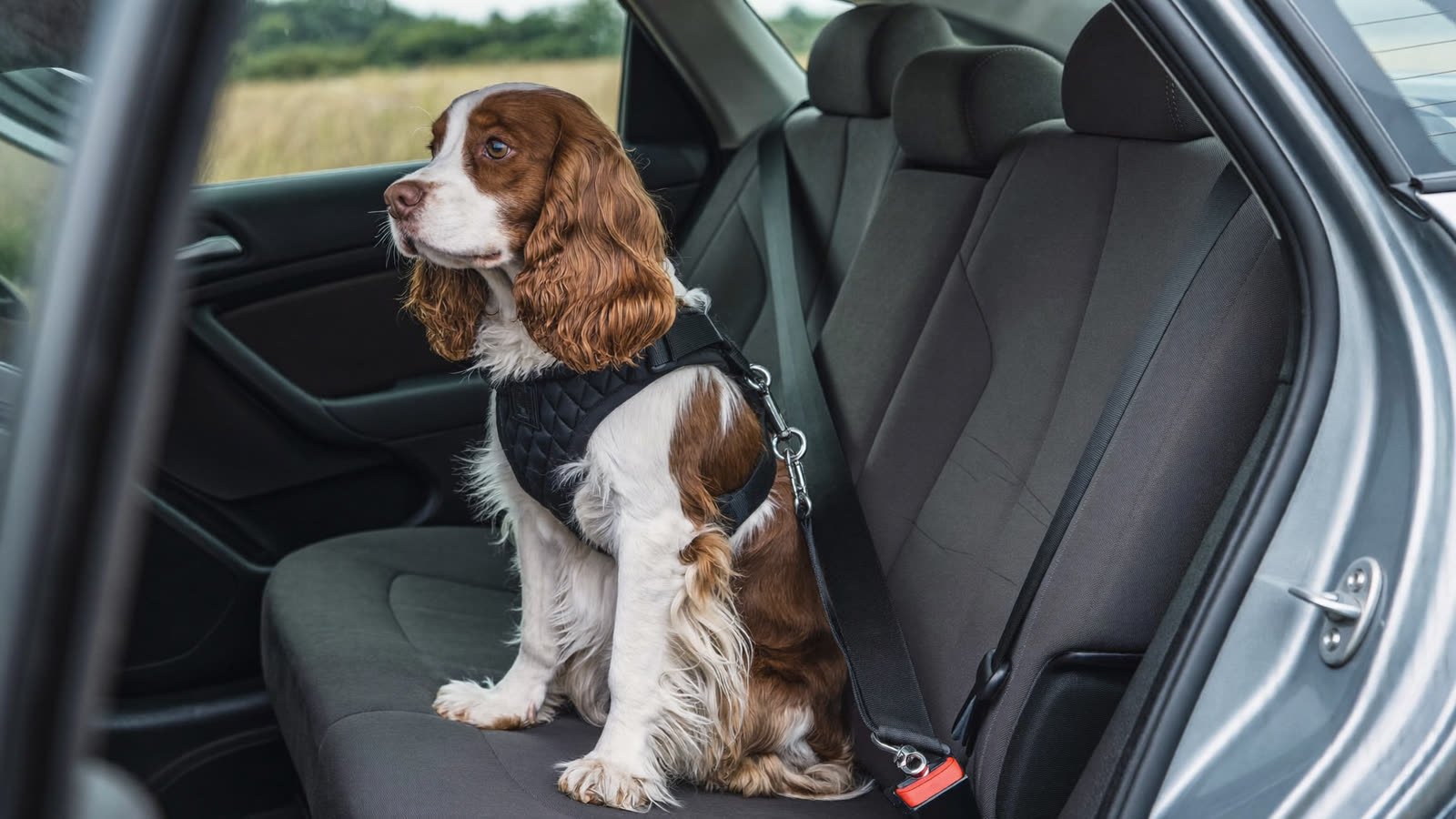
- A crash-tested harness clipped to the seat belt. The most common choice, and the easiest to fit to a car you already own. The harness should spread load across the chest, never clip to a collar.
- A pet carrier, secured so it cannot slide or tip.
- A travel crate, usually in the boot of an estate or SUV.
- A dog guard between the boot and the cabin.
And these do not count, whatever the internet tells you:
- A dog loose on the back seat
- A dog on your lap, or in the footwell of the passenger side
- A lead clipped from a collar to a seat belt — in a sudden stop this loads the whole force of the dog onto its neck
- A boot with no guard, in a hatchback where the boot and cabin are one space
Which restraint suits your car
| Your setup | What works best |
|---|---|
| Hatchback or small car | Harness clipped to a rear seat belt |
| Estate or SUV with a separate boot | Dog guard, or a secured crate |
| Back seat, muddy or moulting dog | Car hammock plus a harness |
| Puppy or small breed | Secured pet carrier |
| Two or more dogs | Individual harnesses, never a shared tether |
If you are weighing up a hammock, we compared fitting types, sizes and anchor systems in our dog car hammock buying guide.
Can my dog travel in the front seat?
Nothing forbids it outright, but it is the worst seat in the car for a dog. A passenger airbag deploys at around 200mph and is designed for an adult human body, not a dog restrained at chest height. If the front seat is your only option, push the seat as far back as it goes and consider deactivating the airbag if your car allows it. The back seat is safer in almost every case.
Leaving a dog in a parked car
Different law, much sharper teeth. There is no specific offence of leaving a dog in a car, but if the conditions cause suffering you can be prosecuted under the Animal Welfare Act 2006. That carries an unlimited fine and up to six months in prison, plus a possible ban on keeping animals.
A parked car heats far faster than most people expect. Even on a mild day the interior can climb well past 40°C in a matter of minutes, and cracking a window makes very little difference. If a dog is in genuine distress, ring 999 rather than breaking a window yourself.
Quick answers
So can I actually be fined for a loose dog?
Not for the loose dog itself. You can be fined for careless driving where the loose dog is the reason you were driving carelessly. In practice that is £100 and three points at the roadside.
Does the boot count as restrained?
Only if it is separated from the cabin by a dog guard, or the dog is in a secured crate. An open hatchback boot does not count.
Is a collar and lead enough?
No, and it is genuinely dangerous. In a crash a dog is thrown forward at many times its own body weight. A harness spreads that load across the chest and shoulders. A collar puts every bit of it through the neck.
Would an insurer really refuse a claim?
They can, and the ground they use is that you were not in proper control of the vehicle. Whether they do depends on the insurer and the circumstances, so check your policy wording rather than assuming.
Does this apply in Scotland and Northern Ireland?
The Highway Code and the Road Traffic Act 1988 apply across Great Britain, and Northern Ireland has its own near-identical Highway Code. The practical advice does not change.
The two-minute fix
Almost every version of this problem is solved by one harness and thirty seconds of clipping in. It is not an expensive fix, it is not a complicated one, and it removes the fine, the insurance argument and the risk to your dog in a single step.
This article is general guidance, not legal advice. Penalties and insurance outcomes depend on the circumstances of the individual case.