
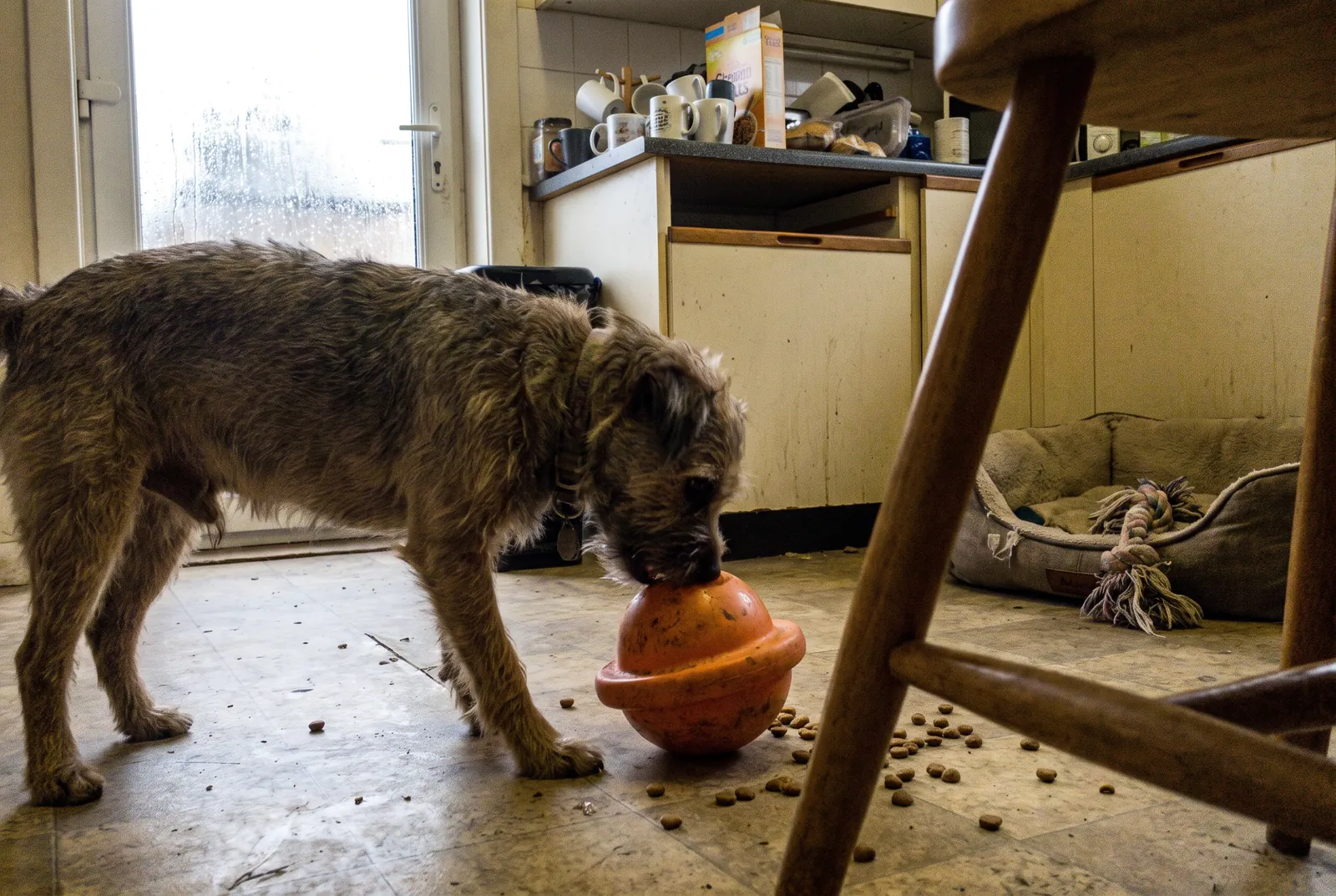
Dog Enrichment Ideas for Rainy Days (From 2 to 30 Minutes)
Short winter walks plus a rainy weekend can leave you with a bored, bouncing dog and a chewed skirting board. Enrichment is the fix. It simply means giving your dog jobs that use their nose, mouth and brain: sniffing, licking, chewing and problem solving. Ten minutes of that tires many dogs out more than a lap of the block.
Why enrichment works
Dogs evolved to work for their food: tracking it, sniffing it out and chewing it. A full bowl in ten seconds removes all of that. Giving some of that work back:
- burns mental energy, which tires dogs out fast
- calms them down, because licking and sniffing are naturally soothing
- reduces boredom behaviours like chewing, barking and digging
- slows down fast eaters. See why your dog eats so fast
Pick by the time you’ve got
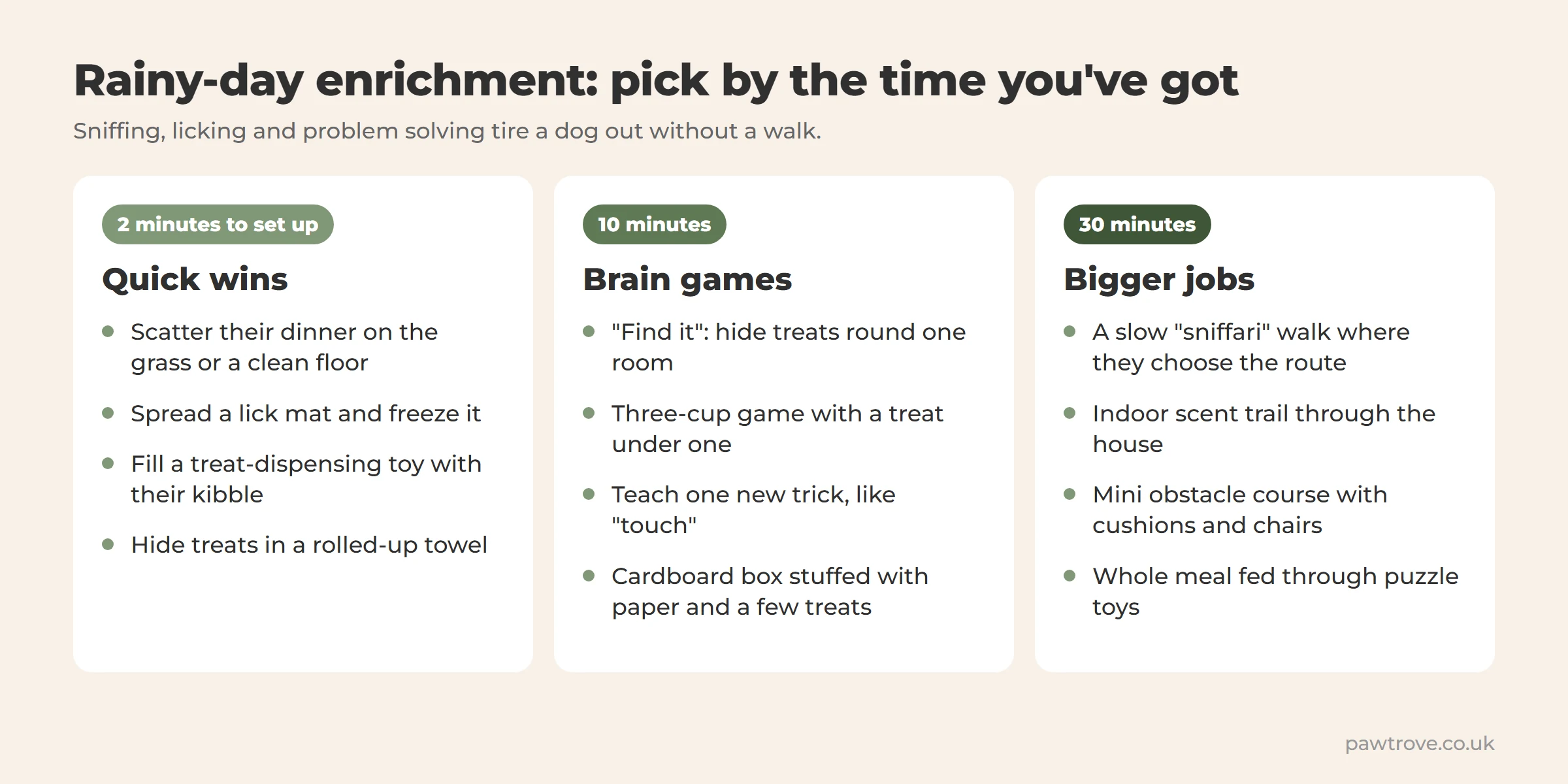
2 minutes to set up
Puzzle-feed a meal
Put their kibble in a treat-dispensing toy and let them work it out.
Scatter feeding
Throw their dinner across the lawn or a clean floor and let them sniff it up.
Frozen lick mat
Spread wet food or plain yoghurt on a lick mat and freeze it. See what to put on a lick mat.
Towel burrito
Roll a few treats up in an old towel and let them unroll it.
10 minutes
- “Find it”. Show your dog a treat, say “find it”, and hide it somewhere easy. Make it harder each round: behind a door, under a cushion, in another room.
- The cup game. Hide a treat under one of three upturned cups and let them nose out the right one.
- Teach a new trick. “Touch” (nose to your hand), “spin” or “paw” are easy starters. Five short minutes of training is surprisingly tiring.
- Shred box. A cardboard box with scrunched paper and a few treats inside. Supervise, and pick up the bits afterwards.
30 minutes
- A “sniffari”. A slow walk where your dog chooses the route and sniffs as long as they like. Short distance, big tiredness.
- Indoor scent trail. Drag a smelly treat along the floor through a couple of rooms and hide it at the end.
- Mini obstacle course. Cushions to step over, a chair to go under, a blanket tunnel.
- Whole meal by puzzle. Split dinner between a slow feeder bowl, a toy and a scatter.
You don’t need to buy anything to start. A towel, a box and their normal dinner will do.
Keep it safe
- Never use chocolate, grapes, raisins, onions, garlic, or anything with xylitol (found in some peanut butters and sugar-free foods). They are toxic to dogs. If your dog has eaten chocolate, our dog chocolate calculator shows how serious the dose is.
- Supervise boxes, paper and toys until you know your dog won’t swallow pieces.
- Count the treats. Take extras from their daily food allowance to avoid weight gain.
- Make it easy at first. A puzzle that is too hard frustrates dogs. Let them win early.
Best enrichment for different dogs
| Your dog | Try |
|---|---|
| Gulps food in seconds | Slow feeder, puzzle toy, anti-gulp insert |
| Anxious or unsettled in the evening | Lick mat, sniffing games |
| High-energy working breed | Scent trails, trick training, shred boxes |
| Older dog or on crate rest | Lick mat, towel burrito, gentle “find it” (check with your vet) |
| Puppy | Easy puzzle toys, short training games |
Quick answers
What is dog enrichment?
Activities that let your dog use natural behaviours like sniffing, licking, chewing and problem solving. It keeps them mentally busy, not just physically tired.
How much enrichment does a dog need?
A little every day helps most dogs. Even feeding one meal from a puzzle toy makes a difference.
Can enrichment replace a walk?
Not fully, but on very cold, wet or icy days it is a great way to make up for a shorter walk.
Are treat-dispensing toys good for dogs?
Yes, for most dogs. They slow eating, add a job to mealtimes and keep dogs busy. Pick one that suits your dog’s size and adjust the difficulty.
Turn dinner into a game
Treat-dispensing toys, lick mats and slow feeders from £10.99, with free UK delivery.
See the treat toy →